
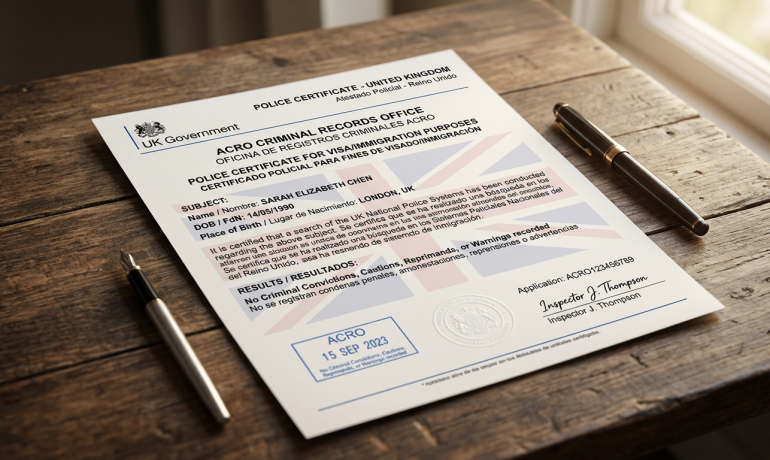
This FAQ covers common questions about translating police certificates, police clearance certificates and related criminal-record documents for use in the UK or with UK authorities. Requirements depend on the receiving organisation and the purpose of the document, so always check the instructions for your specific application.
What is a police certificate translation?
It is a translation of an official police or criminal-record document from one language into another. The document may be called a police certificate, police clearance certificate, criminal record certificate, certificate of good conduct or a similar name depending on the issuing country.
When is a certified translation required?
A certified translation may be required when the receiving organisation asks for an English version of a document issued in another language. For UK immigration applications, check the current document list for your visa route first. Where a required document is not in English or Welsh, route-specific GOV.UK guidance may require a certified translation.
Does every UK visa applicant need a police certificate?
No. Police-certificate requirements vary by visa route and circumstances. Some work routes require criminal-record certificates only for specified jobs or applicants. Check the current GOV.UK requirements for your route before obtaining or translating a certificate.
What should the translation cover?
The translation should accurately reflect the relevant visible information on the original, such as names, dates, certificate numbers, issuing authority details, record statements, stamps, seals, signatures and official notes. Legal terminology should be translated carefully without changing the meaning of the source document.
Is an ACRO certificate the same as a DBS check?
No. ACRO police certificates and DBS checks are different documents used for different purposes. UK-issued ACRO and DBS documents are normally already in English. Translation is more likely to be relevant when a foreign police or criminal-record document is being used in the UK, or when a UK-issued document is being used in a country that requires another language.
Do police certificate translations need notarisation or an apostille?
Not automatically. Certified translation, notarisation and apostille legalisation are separate requirements. The receiving organisation should tell you what it needs. If you have written instructions, send them with the document so the correct service can be confirmed before work begins.
Can I translate the document myself?
If the receiving authority asks for a certified translation, a self-translation will not normally satisfy that requirement. Follow the instructions supplied by the authority or application route.
How long does police certificate translation take?
Turnaround depends on the language pair, document length and legibility, certification requirements and requested service. Send the complete document and your deadline so the available options can be confirmed.
How much does police certificate translation cost?
Pricing depends on the document, language pair and requested service. For price-focused information, use the dedicated police certificate translation cost guide rather than relying on a generic fixed range.
Where can I order the translation?
If you already know that your document needs translating, use our police certificate and criminal record translation service. For UK immigration-specific guidance, read the police certificate translation for UK immigration guide.
